A pre-competition training session, filmed from the side of the table — a forehand pendulum serve, then two backhand drives. About ten seconds. This is the read as Kai's family would see it, about a minute after the upload.
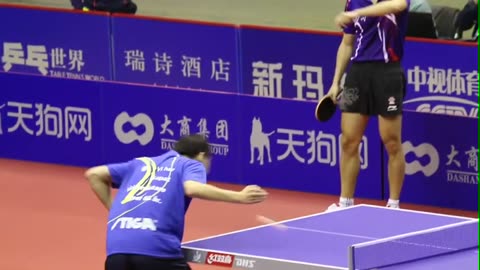
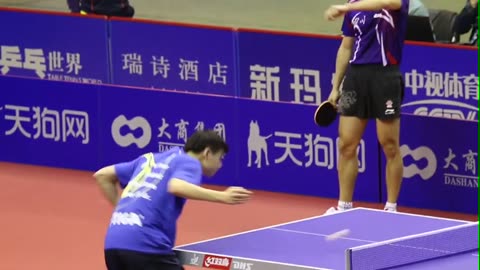
Kai serves a low forehand pendulum serve and then hits two strong backhand drives, and overall it looks lively and well-balanced, with the backhand finish a little over-stretched.
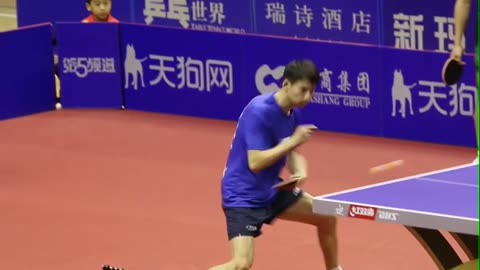
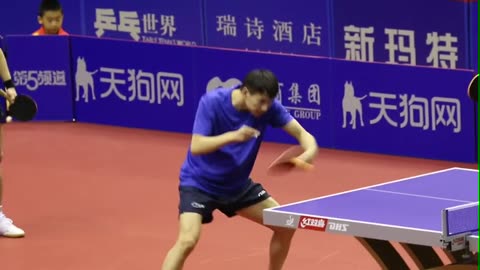
Clip: “Pre-competition training, 1 November 2017” by Pei Luoyang on Wikimedia Commons, used under CC BY 2.5. Frames are the ones the app sampled.
Working well
- ✓Serve contact is right down at table height with the whole body folded over the ball (burst 1, frame 3)
- ✓He stands up and is back in a ready position within a few frames of serving (frames 6 to 10)
- ✓Feet are busy on the backhand drives - you can see steps and leg blur between frames 11 and 14 rather than a planted stance
The one fix
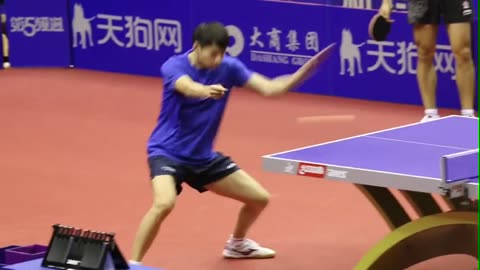
Stop the backhand at shoulder height in front of you with a small bend still in the elbow
Say it courtside“Stop the backhand at shoulder height in front of you with a small bend still in the elbow, then bring the bat straight back to your chest.”
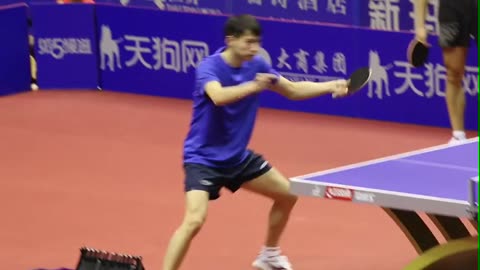
In frames 13 and 28 the arm locks out fully straight and the bat is a long way from his body, and in frames 14 to 16 it then sags down to the knee before he can get ready again; that costs him time before the next ball. A shorter finish and a straight-line recovery would buy him an earlier ready position and a more repeatable contact.
Checkpoints
- GoodServe toss and body position
Frame 1 shows the free hand raised for the toss and frames 2 to 3 show him bending low over the table with the bat dropped to ball height, which is sound pendulum-serve shape.
- GoodServe contact point
Frame 3 is closest to contact, with the bat almost at table level and the ball visible just above it in frame 4, so he is striking the ball low, which keeps the serve low.
- GoodServe recovery to ready
Frames 6 to 10 show him rising and squaring up with the bat in front of the body while the ball is still on the far side.
- CloseBackhand drive finish (first drive)
Frames 11 to 13 show the bat at shoulder height and the arm fully straight and blurred at the far end of the swing, so contact is at or just before frame 11; the finish reaches further than it needs to.
- Fix thisBackhand recovery path (first drive)
Frames 14 to 16 show the bat dropping to knee height before coming back up to the chest in frames 17 to 19, which is a slow route back to ready.
- CloseBackhand drive shape (second drive)
Frame 27 has the bat compact in front of the chest with the elbow leading and frame 28 has the arm fully extended forward at shoulder height, so contact sits around frame 27; the rebuild to a compact ready position in frames 29 to 30 is quick, and the earlier low reach over the table in frames 21 to 22 is only partly captured.
- GoodWeight transfer on the backhand drives
Comparing frames 11 to 14 and 25 to 28 the stance width changes and the legs show motion blur, so he is moving through the ball rather than standing still.
Drills that fix it
- 1Shadow backhands in front of
Shadow backhands in front of a mirror or wall, stopping the bat at shoulder height each time and touching it back to the chest before the next swing
- 2Ten slow backhand drives against
Ten slow backhand drives against a partner or robot with one job only: bat back to chest before the ball crosses the net
- 3Serve then one backhand
serve, recover, and hit a single compact backhand drive off the return, repeating the pair five times
Setup tip. If a robot is available, feed slow, medium-height balls to the backhand corner at a gentle pace so there is time to feel the shorter finish and the straight-line recovery.
Real clips and real reads. Each clip is free-licence footage — from Pexels, or from Wikimedia Commons under CC BY — credited under its frames; the players are called by pseudonyms. The frames, observations, grades, drills and confidence are the AI coach's own, produced the way the app produces them — the same sampling, the same prompt, the same model — and nothing was added to what the frames show. Every read is saved to the family's account with the film, and a connected coach can open it.
Getting a read of your own
- 1Film a few strokes
Phone from behind or beside the court or table, ten to thirty seconds, one or two drills. Photos or filmed in the app.
- 2Upload it
Pick the clip, name the player, tap Analyze. $1.99 a clip — your first 90 credits are free.
- 3Read it in about a minute
Close the app if you like; the read arrives. Ask your coach to look — the read goes with the film.
Works for table tennis, tennis, badminton and pickleball — see each sport.